Art + Neuroscience = Laurie Frick
/By Jesc Bunyard in Rooms Magazine
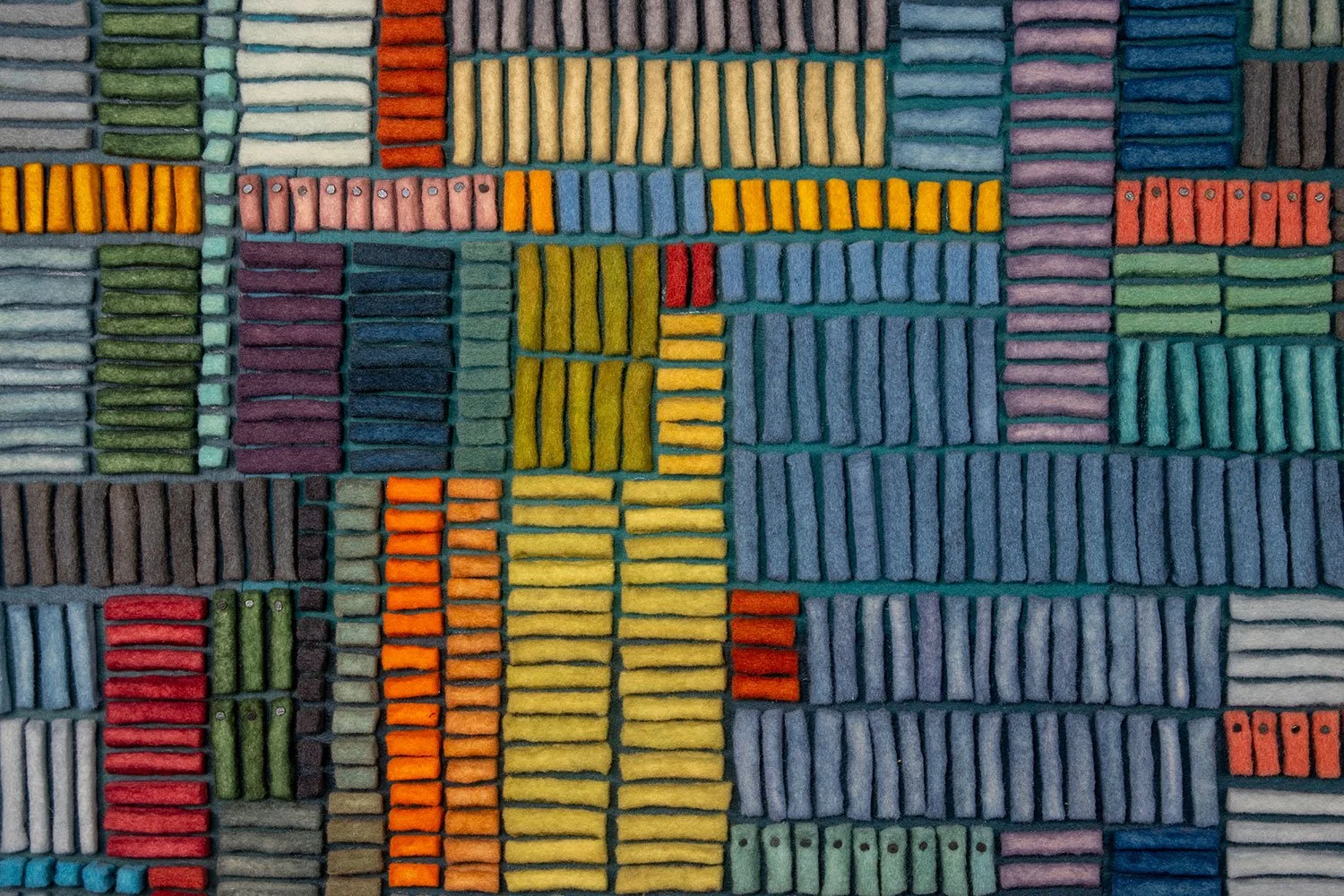
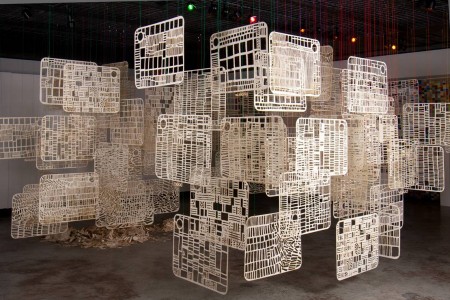 Laurie Frick’s work treads the line between art and neuroscience. Frick uses self-tracking to map out everything in her life, which then gets transformed into beautiful 2D works and installations. Frick’s practice therefore is human existence in data form, made more tangible for the viewer.
What is self-tracking?
It’s about measuring something of yourself, the most interesting tracking comes from capturing something very familiar that you don’t notice. Such as how many times you wake up during the night, your minute-by-minute heart-rate or how many steps you take each day. What used to be something of an oddity, has now become so easy with iPhone apps and gadgets. Self-tracking has exploded into whole movement, called the Quantified-Self.
Your work draws inspiration from neuroscience and from your background in engineering and high-technology. What is it that makes the topics so interesting to you?
At this moment in time biotechnology and neuroscience are exploding, it’s where the biggest breakthroughs in science will come over the next decade. The moment that neuroscience was able to study live human brain activity using fMRI – what we call ‘brain scans’ the field of neuroscience research went into lightspeed. In my lifetime, we’ll begin to understand one of the last true mysteries on the planet – the human brain.
I’m halfway through my 2 year artist-in-residence program at the Poldrack Lab at UT. It’s the Neuroscience Research Center at the University of Texas, Austin, headed by Russ Poldrack, and filled with PhD’s. I get to hang out with them and let some of their smarts and research seep into my artwork.
What visual/aesthetic decisions go into transforming the information into art works?
I have this idea that in the not-so-distant-future, data gathered about us will turn into physical patterns that we display as art. Human data portraits. These patterns are unique to us, and yet unconsciously recognizable as human… as us, familiar and reassuring. I try to look at the data and make a fifty-fifty decision about how to convey what is getting measured with what that data means, and the experience surrounding it. Almost a visual language for conveying human pattern.
Do you decide what data goes in which piece, is one piece made up by category e.g. heart rate, or is a piece made by the data in one day?
I think of the art and each piece I create as ‘experiments’ trying to see if I can make a visual representation of the measurements and help the patterns feel compelling and interesting. So far I’ve taken single measurements that I really understand and make installations and works from those. Combining measurements to see correlation between them, such as did the amount of walking affect sleep or weight is much, much harder. But, measurements over time are always a consideration. I like to work in chunks of time of a day or a month, it’s similar to how we normally see ourselves.
Where would you consider your work to sit in relation to both art and neuroscience? It’s squarely in the art-world, but I have this fantasy about artists seeing something of the future and eventually it turns out to be proven science. I hope that before I die, neuroscience and projects like the Human-Connectome which is mapping the human brain will find patterns or rhythms of the self that can be reflected in the visual world.
What visual/aesthetic decisions go into transforming the information into art works?
I have this idea that in the not-so-distant-future, data gathered about us will turn into physical patterns that we display as art. Human data portraits. These patterns are unique to us, and yet unconsciously recognizable as human… as us, familiar and reassuring. I try to look at the data and make a fifty-fifty decision about how to convey what is getting measured with what that data means, and the experience surrounding it. Almost a visual language for conveying human pattern.
Do you decide what data goes in which piece, is one piece made up by category e.g. heart rate, or is a piece made by the data in one day?
I think of the art and each piece I create as ‘experiments’ trying to see if I can make a visual representation of the measurements and help the patterns feel compelling and interesting. So far I’ve taken single measurements that I really understand and make installations and works from those. Combining measurements to see correlation between them, such as did the amount of walking affect sleep or weight is much, much harder. But, measurements over time are always a consideration. I like to work in chunks of time of a day or a month, it’s similar to how we normally see ourselves.
Where would you consider your work to sit in relation to both art and neuroscience?
It’s squarely in the art-world, but I have this fantasy about artists seeing something of the future and eventually it turns out to be proven science. I hope that before I die, neuroscience and projects like the Human-Connectome which is mapping the human brain will find patterns or rhythms of the self that can be reflected in the visual world.
Making work
/ Hate to have so much time go by without an update. Had a little talk with myself that all energy needed to go into the making of work for this year. From a distance the life of a working artist looks leisurely with no boss, no deadlines and lots of time. Right.
Am juggling work for 2 upcoming shows, a lobby installation, commission, group show, couple benefits and two upcoming art fairs.
On the measurement side, have been analyzing all the data I'm getting from my Basis watch (we hacked the download of data - cause they are offering no data export, ugh). From little sensors on the wrist side of the watch strap, it measures pulse, air temperature, skin temperature, galvanic skin response, calories and movement. Once every minute. It's a ton of data, but you get a very interesting picture of 'you', and in this case, me....over 24 hours, day after day. Have been fiddling with how the data tells a story, stay tuned...will post soon.
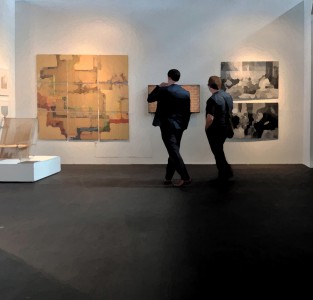
The image here has just been sitting in my pic file, and it grabs me everytime I see it...something about the movement and stance of the 2 viewers...the fact that they were both wearing black and seem to have come to really look at work in the booth. Was a great fair, and Edward Cella did a superb job at this show.
OK, back to work.
Austin scientist self-tracking experiment includes 3x weekly brain scan
/Austin NPR story about self-tracking, and Russ Poldrack's brainscanning as part of his year-long measurement study. I chat a little about tracking my upset stomach. Here's the newsbit plus 7 min radio story. Russ runs the Neuroscience lab at UT, where I'm artist-in-residence. Listen to the radio story here.
This Austin Scientist is Scanning His Own Brain Over 100 Times
By Matt Largey, KUT News

UT neuroscientist Russ Poldrack is studying his own brain, looking at how it changes over time.
At 7:30 am on pretty much any Tuesday over the past 8 months, you'd find Russ Poldrack lying on his back in front of the MRI scanner in his basement lab at UT, waiting to scan his brain.
Poldrack, a neuroscientist, runs the Imaging Research Center at UT-Austin.
I met him on the morning of his 58th scan.
“The first few times, I was quite anxious laying in there," Poldrack said. "But 50 times doing anything, you become more relaxed in doing it.”
Poldrack gets one of his regular Tuesday brain scans in the MRI machine in his basement lab. His assistant, Ashleigh Hover, runs the scanner.
All these MRI's are aimed at trying to answer a pretty fundamental question about all of us: How much fluctuation is there in a healthy brain over time? But also – how do those fluctuations translate into real things?
“So for example," said Poldrack, "how does that relate to my mood from day to day or how well I slept and also how does it relate to what’s going on in my body?”
Put simply: How do changes in our brains affect how we feel or how we act?
To find out, Poldrack is tracking virtually every aspect of his daily life. When he wakes up every morning, he takes his blood pressure, weighs himself and takes a survey about how he slept and how he's feeling that morning. Some days, he gets blood taken and analyzed. Each night he takes another survey to track what happened that day — what he ate, if he drank any alcohol or took any medicines.
Then there are the MRIs. He’s been doing at least two scans a week since September, with the exception of a brief hiatus this spring.
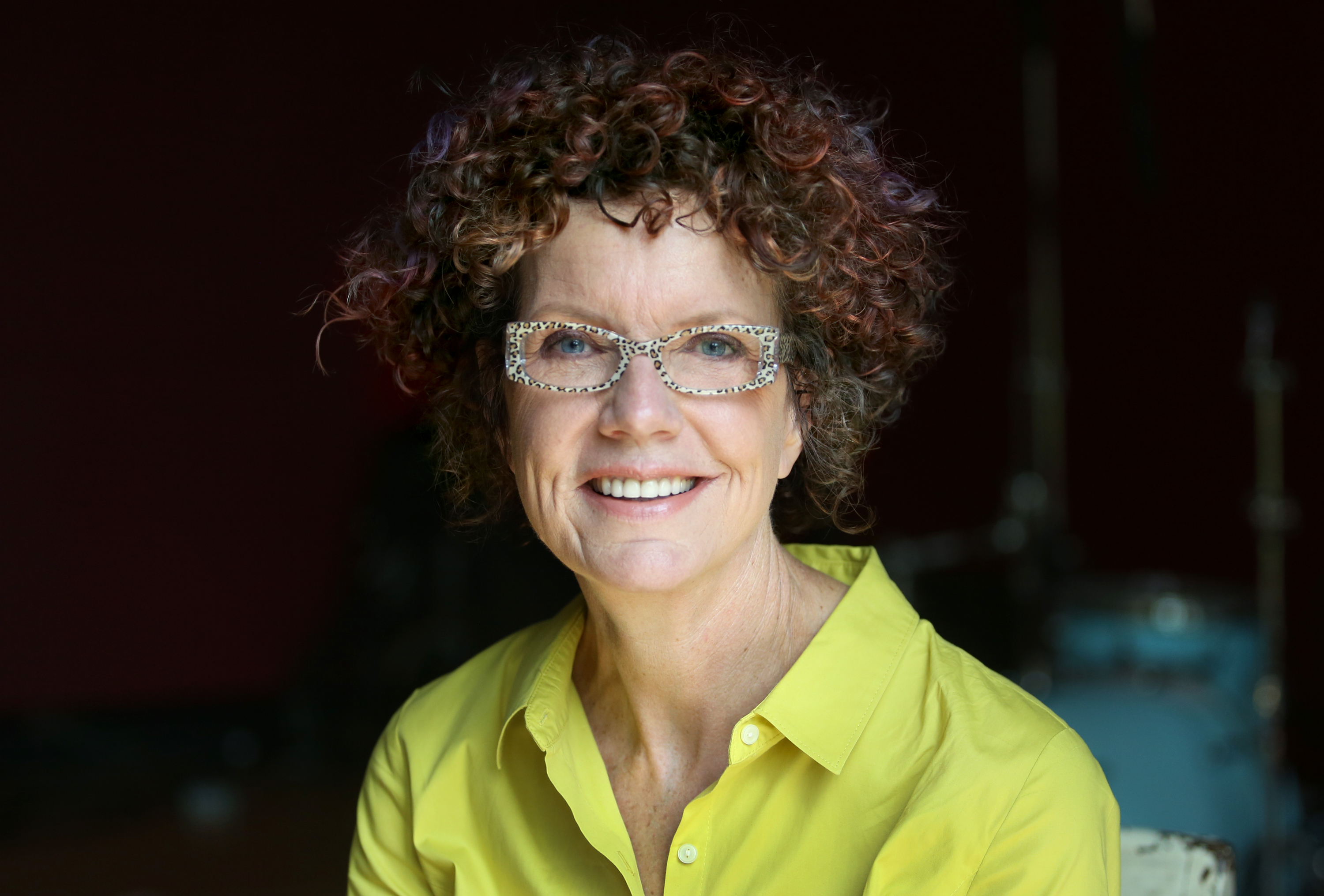
So why is Poldrack – the scientist – the one having his life tracked this way, instead of a test subject? Poldrack says the inspiration came from an artist by the name Laurie Frick, who's sort of an artist-in-residence at Poldrack's lab. Frick has been tracking herself for years and making art from the data. But she got started with a more practical purpose.
Credit Jorge Sanhueza-Lyon/KUT News
Austin artist Laurie Frick was one of the inspirations for Poldrack self-tracking study.
“I’d been having these stomach aches on and off for years and years and years," Frick said. "And I thought ‘alright, I’ll start to score it every day.’”
She used an app to track what she ate, what she did each day and some other factors. “And after about a year I decoded it," she said. "By tracking it, I figured out what were the causal effects of an upset stomach.”
And in a sense, that’s just what Poldrack is doing. He's tracking little things to try to get big answers.
After his MRI, Poldrack takes his blood pressure for the second time that day. Then, over to a computer to use an online form to answer a few dozen questions about his mood. Is he feeling proud? Shy? Bashful? Frightened? Poldrack rates himself for each on a scale of 1 to 5.
Let’s say he's feeling a little blue one day. The idea is to compare his brain scans from that day to ones from days when he’s feeling happy or just neutral.
Can you actually see something in his brain has changed?
But shouldn’t a real-deal scientist be doing this a little more by the book? Test subjects, control groups – you know, a real study?
Poldrack says there’s just one problem with that.
“Imagine expecting volunteers to come in off the street, say, once a week for a year…have their brain scanned, have blood drawn…that’s a really hard study to expect people to take part in.”
Poldrack is hardly the first scientist to use himself for an experiment.
A few years ago, Trevor Norton, a retired professor of marine biology, wrote a book called Smoking Ears and Screaming Teeth. And it’s about the long history of scientists who made big discoveries by experimenting on themselves. “Isaac Newton in the 16th century…John Hunter in the 18th Century...it was an American dentist [Horace Wells] who was the first one to try anesthetics properly.” One of the inventors of the MRI tried out an early version of the machine (unsuccessfully) on himself.
And while Poldrack isn't trying a new medical tool or taking some untested drug, there’s something idealistic about what he's doing. It’s the kind of science you don’t see much of anymore.
“It’s not a matter of getting really good data," said Norton. "It’s ‘Who goes first?’”
After the MRI and the blood pressure and the mood survey, Poldrack goes to get some blood drawn. It will be analyzed to isolate the RNA — which carry the blueprints to make proteins. The results of the analysis will tell him which of his genes are being expressed that day. Then, he can compare that to all the other data to see if it corresponds to any changes in brain.
Whatever he learns is obviously just a first step. The idea is to find specific questions to ask in the future.
"Whatever we find in this study will really provide us sort of places to look," Poldrack said.
Credit Matt Largey/KUT News
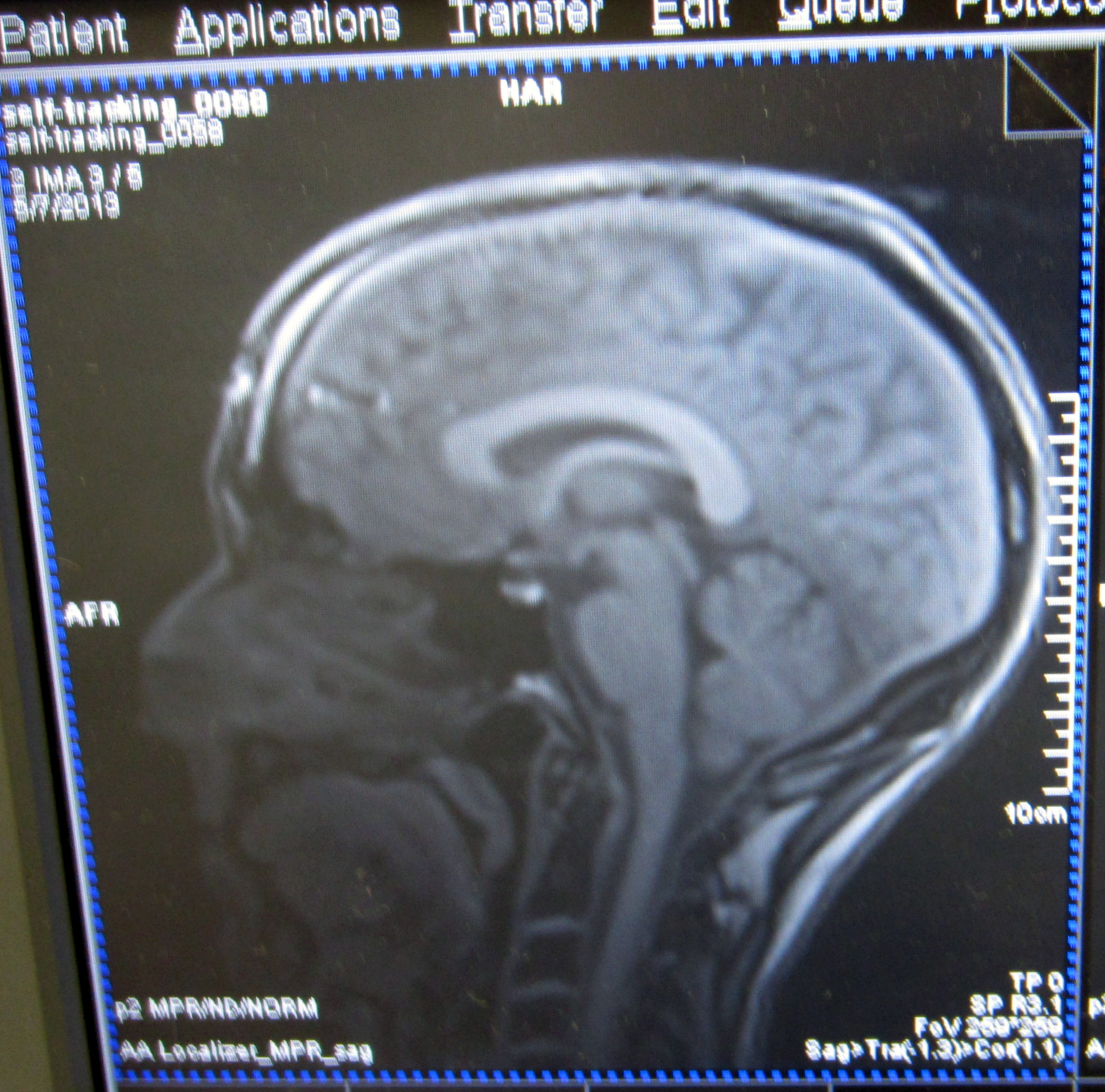
An image of Poldrack's brain from an MRI on May 7, 2013.
Those questions are already starting to take shape. A little more than halfway through, Poldrack is seeing some patterns emerge.
“For example, we see some relationships across days between my general positive mood and brain function," he said. "We also see some relationships between my blood pressure on those days and brain function. So we’re starting to see some patterns. There’s still a lot more to do, because we need a lot more data.”
Poldrack will keep collecting data on himself at least through the end of the year. After that, he’s hoping to find some brave volunteers to take his place in the MRI machine.