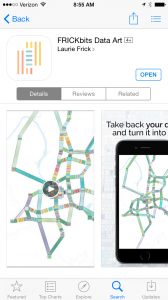
It looks a little obscure, but Jennifer Lepies from Business Geomatics sent me a note last week saying "... I meant to write something about geo data connecting with art for a long time, your idea and the upcoming app FRICKbits seems to be perfect."
You describe yourself in your CV as a "data artist". You have a background in engineering and high-technology. How come you finally got hooked on art? Even so intense that you went back to school for it.
I was always a ‘Maker’, and for my whole life was always making things. Even when I worked in tech, I ran a computer hardware team that created and made new consumer products. My mother and sister were artists, it didn’t seem that odd to me. What I learned from art school is that you pull from your own experience, and my experience was the love of data and technology.
How did it happen that you got your first steps to the iphone app?
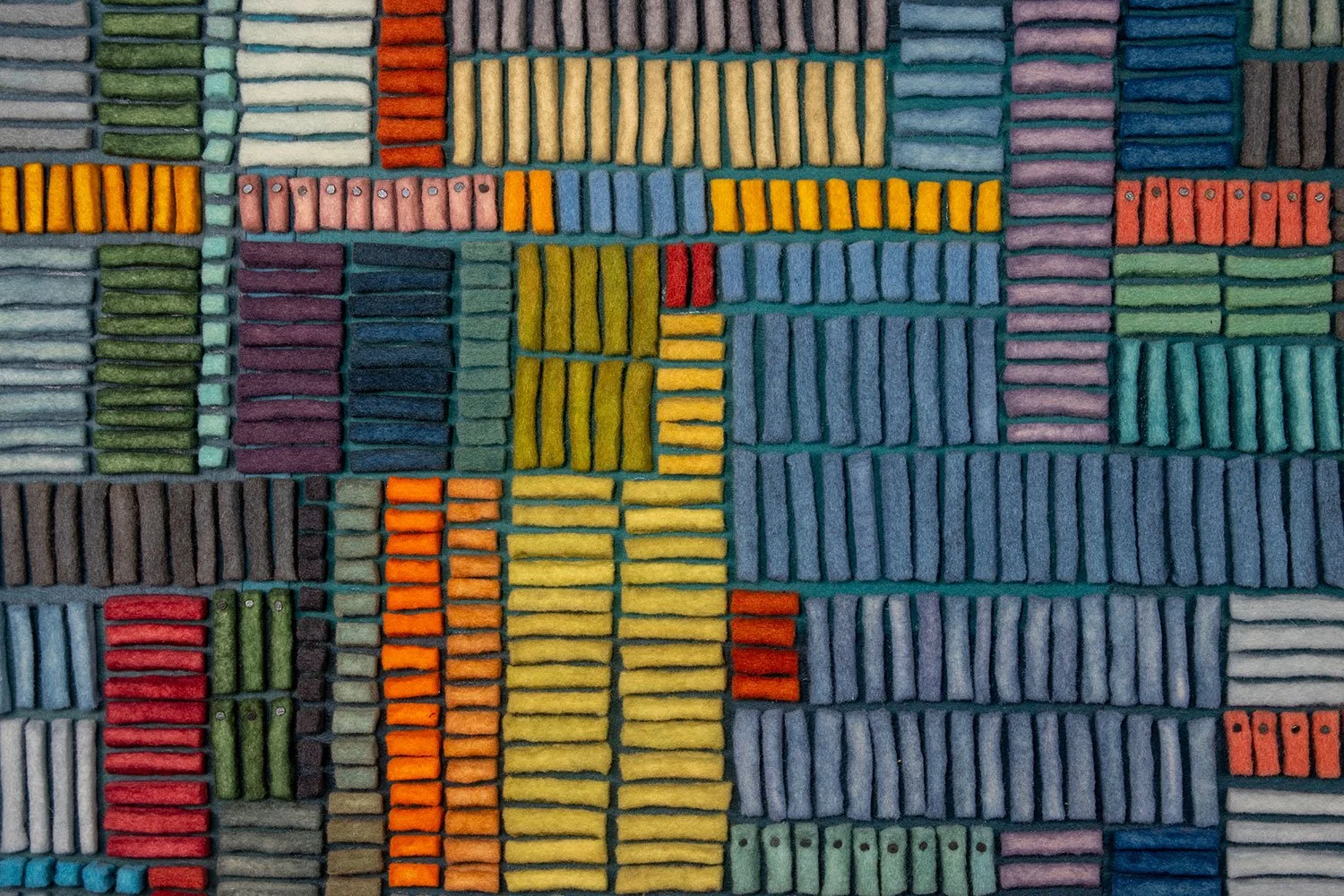
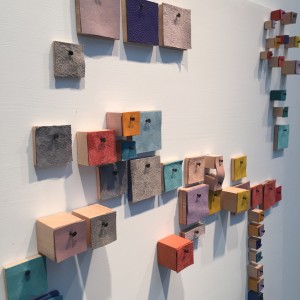
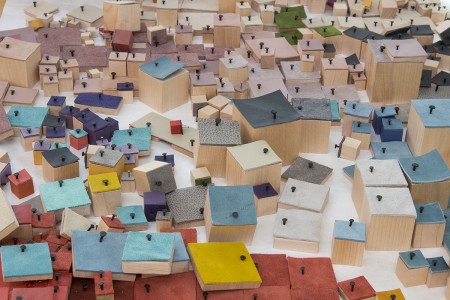
Mostly I make hand-built artwork from self-tracking data. After making a studio full of wall size patterns from weight, sleep, daily time, internet use, mood, walking and location data I could see we unconsciously have very eloquent rhythms. We recognize something human in these data patterns, and don’t know why it feels familiar. I thought “why can’t everyone have human data portraits of themselves?” Maybe the future is 3D printed textured wallpaper from our data…but in the meantime, how do we do this on an iPhone? We all carry a phone everywhere, maybe that is the best place to keep a data portrait with you at all times.
How does the program FRICKbits work? Which data sets are used for the portrait? And how do the color patterns evolve?
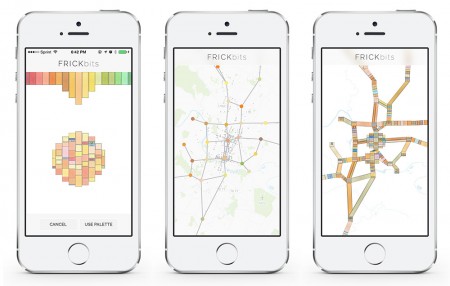
We imagined FRICKbits could produce pattern from an algorithm, a set of rules that draw colored pattern based on a set of measurements. I had made a series of hand constructed artworks that combined steps, GPS location, weather and scenery to make abstract collage, that were actually based on a bunch of measurements. We used this idea and simplified it, knowing we can add more complexity to the algorithm later on. FRICKbits uses GPS location data that we down-sample and abstract into line and bits based on frequency of travel. It’s organized so things keep to a grid. Color palettes are made to feel like the light and color of a city or place. You earn small bits and clusters for the places you go all the time, like home and work. It’s vector based, but we modeled the look after a series of my watercolor pattern portraits.
Before you started transforming location data /tracking data into art you gathered all other sorts of data like internet use, sleep or weight. What is - as an artist - so special and appealing about location/tracking data for you?
Everyone has now been trained to see maps from a google view, we used to hand-draw little diagrams for each other to find our house, or find our way to a party. Now we always see our travel path in perfect accurate scale. But -- that’s not how we remember it. We don’t recall or reconstruct our physical travels in linear time or with accurate coordinates. It’s a good metaphor for art. After tracking my location for years now, I could see we tend to travel the same places repeatedly, and occasionally venture outside our normal rhythms. The pattern of where you move in a city or travel is a very personal type of portrait, a GPS ‘location-selfie’.
 Nowadays collecting data to use it for some reason is sort of a sore spot. Can you explain why you go with your FRICKbits app to that "wound"?
Right now, it hurts when people talk about the data surveillance of their personal habits. Lots of data is tracked about us and it’s hidden or simply not shared. As a data activist, it feels like we’ll get further if we don’t hide, but demand more. I love the things I learned from self-tracking. I say, go the other way, and push companies to share your data back with you. I bet people would be astonished with how much is known about them, and the patterns extrapolated and predictions made about them.
People look at me and ask “what would I possibly do with my data?” – “Turn it into art!” I say. It’s not so crazy, it’s another version of a data-selfie. How else will be begin to shift the equilibrium and have a chance as individuals to fight back, and have a say about the data collected on us?
FRICKbits is a project on kickstarter these days. The campaign still runs until September 7th. The pledge was 7,500 US-dollars and the people already contributed almost 3 times that amount. You're probably quite happy about that result?! How does it bring FRICKbits forward?
Yes, I was stunned. I think people are starting to realize they want their data to mean something, to take it back. We learned from our initial beta testing this month that users were captivated by their travel patterns, but it wasn't enough to see the art-patterns animated on the screen. Because it’s an app, they wanted to play with it, have a little more control to manipulate their personally made data portrait. We’re scrambling to add some gesture controls, and then add a way to print out what you've created. I’m using the funds raised for more development to make FRICKbits work better. It’s really exciting.

 The "tyranny of tiny tasks," as Wu called it, may only get more tyrannical if the Apple Watch draws in more developers and users, pushing the smartwatch beyond the early adopter community. Computers shifted us from writing occasional time-consuming letters to writing a mounting number of emails. Smartphones allowed us to fire off an exponentially larger number of emails as well as quicker messages through other applications."
 You know who you are by where you are in TIME. When you get knocked out, and come to….the first thing the doctor asks is “what is your name” …and “what day is it?” Who you are and where you are in time is vital to your grasp of consciousness, your sense of self.
 It’s become so easy to track your time, I turned Moment on my iphone and know how often I touch the screen and how many minutes I looked at my phone today. Manictime on my laptop tracks every click, every website and app I use. Some days it’s scary how many hours I spent online when I thought I was making stuff in the studio all day. Think of everything else that tracks your time.... your car knows how fast you pressed on the gas pedal and every minute you drove today. The MTA pass, the security swipe at work, your front door probably knows when you walked into your apartment.
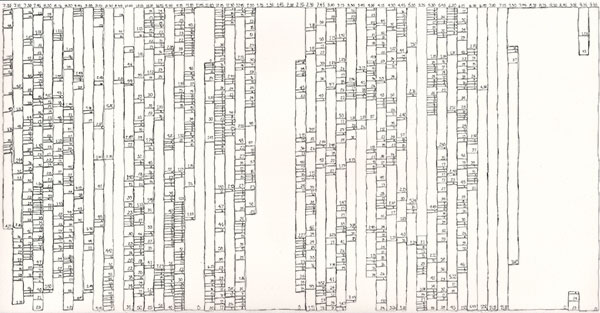 Which is all very curious because I'm investigating the notion that YOU are your time, you are defined by how you spend your time, the activities and even unconscious use of time says loads about your psyche, your personality and your inner-self. Your sense of who you are is based on the recollection of recent events, and what you are doing and intend to do. It's your basic orientation in the world.